
The Evolution of Cognitive Scaffolding: Why AI Expedites Thinking Rather Than Reduces It
The Evolution of Cognitive Scaffolding: Why AI Expedites Thinking Rather Than Reduces It
🌱 Seed Note This note explores how society thinks about mental effort and technology. It unpacks why we trust centralised search algorithms while distrusting steerable AI models, and looks at the 2,400-year history of panics over new thinking tools. Connected garden notes: From Gemini Chats to Signals: Why I Built a Digital Garden, Welcome to my digital garden, Building a Modern Digital Garden with Angular 22, SSR, and Markdown.
1. The Central Thesis: Cognitive Scaffolding
Whenever a new thinking tool arrives, society makes the exact same mistake: we confuse saving manual legwork with losing brain power.
When technology removes tedious, mechanical effort, the immediate reaction is always: "This is making us lazy. People aren't thinking for themselves anymore."
Yet history shows that human thinking doesn't shrink when manual friction disappears—it steps up to a higher level. Generative AI doesn't reduce thinking; it serves as the next layer of cognitive scaffolding.
Just as Google Search spared us the physical slog of digging through library drawers and dusty book stacks, Generative AI handles early drafting, routine structure, and initial synthesis. This frees us up to focus on what matters most: high-level architecture, sharp editing, critical evaluation, and creative direction.
2. The Search Paradox: Opaque Retrieval vs. Steerable Synthesis
Think about the double standard we live with today: Why do we trust Google Search without a second thought, while viewing Generative AI with deep suspicion?
Google Search is an opaque, centralised black-box algorithm. It silently filters and ranks what we see based on ad revenue and SEO tricks. Yet we accept it as normal. Meanwhile, Generative AI—a tool that directly responds to our instructions and can be steered in real time—makes people nervous.
There are three straightforward psychological reasons for this:
1. The Illusion of Choice vs. Direct Answers
- Google Search (Retrieval): Gives you a page of ten blue links. Because you decide which link to click, you feel in control—even though Google's algorithm chose which ten links made the cut in the first place.
- Generative AI (Synthesis): Gives you a direct, structured answer. Because it delivers a unified response rather than a list of links, it can feel like a take-it-or-leave-it answer, disrupting our familiar habit of clicking around.
2. Predictable Lookup vs. Probabilistic Reasoning
- How we view Search: We treat search engines like digital librarians looking up fixed, existing documents.
- How AI works: Large Language Models reason using probability. When an AI makes a mistake or hallucinates, we are reminded that it's generating new text rather than reading off an index card. Because we value predictability, an occasional AI hallucination feels more unsettling than a biased search result.
3. The Shift from Searching to Steering
- For 25 years, we were trained to be passive searchers: type keywords $\rightarrow$ click top link $\rightarrow$ scan page.
- Generative AI requires us to be active directors: setting context, giving clear constraints, refining tone, and steering the output like an editor-in-chief.
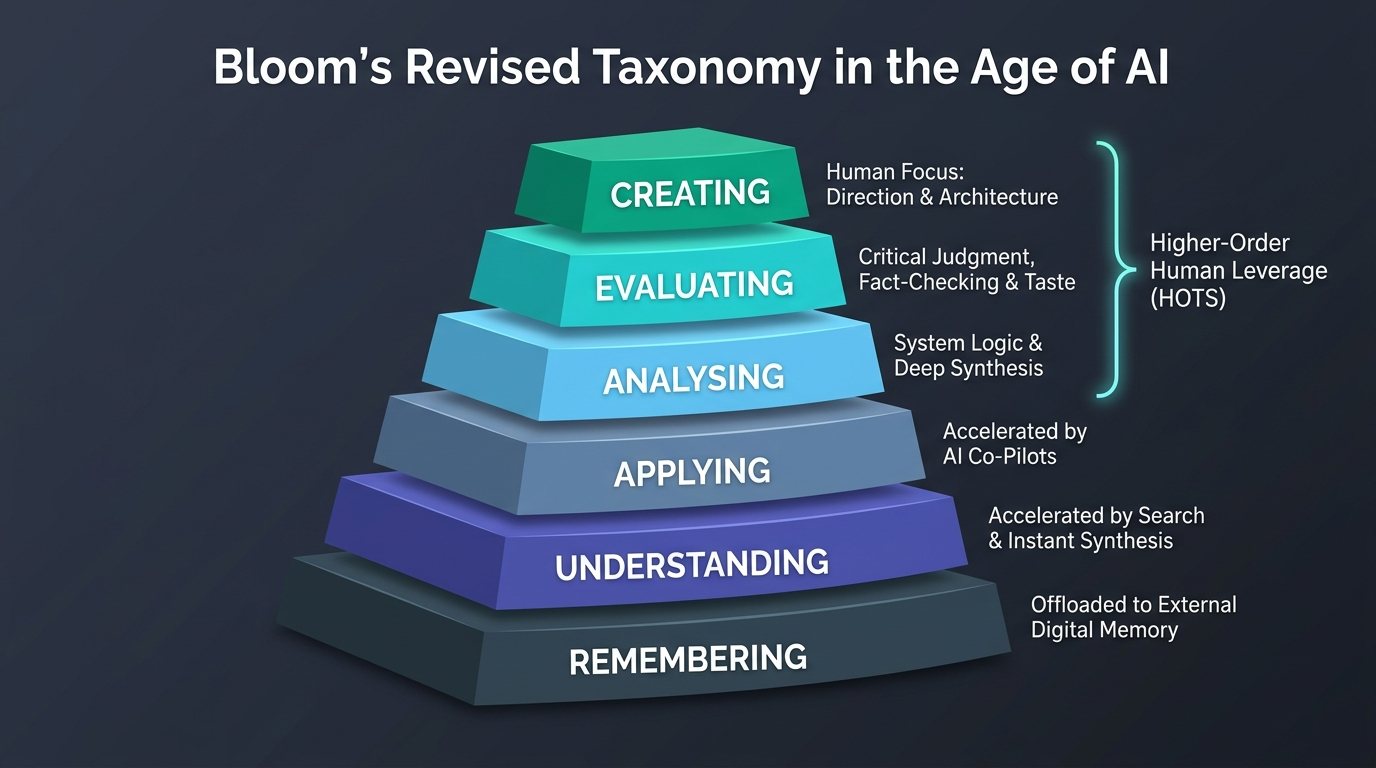
3. Bloom’s Taxonomy: Raising the Cognitive Baseline
When critics claim AI tools require "less brain power", they are often suffering from Generational Amnesia—the habit of treating whatever technology we grew up with as the only "authentic" way to work.
We can see how technology shifts human effort by looking at Bloom’s Revised Taxonomy of Educational Objectives (Anderson & Krathwohl, 2001):
📚 Academic Foundations:
- Original Framework: Benjamin S. Bloom et al., Taxonomy of Educational Objectives: The Classification of Educational Goals (1956).
- Revised Taxonomy: Lorin W. Anderson & David R. Krathwohl (Eds.), A Taxonomy for Learning, Teaching, and Assessing: A Revision of Bloom's Taxonomy of Educational Objectives (Longman, 2001).
- Pedagogical Reference: Vanderbilt University Center for Teaching — Bloom’s Taxonomy Guide.
- Lower-Order Skills (Remembering & Basic Lookup):
- First offloaded to writing, then encyclopaedias, then search engines, and now handled effortlessly by AI models.
- Higher-Order Skills (Analysing, Evaluating, Creating):
- When manual drafting and routine boilerplate are automated, the baseline rises. Human intellect is freed to focus on high-impact decisions: verifying facts, evaluating quality, and shaping original ideas.
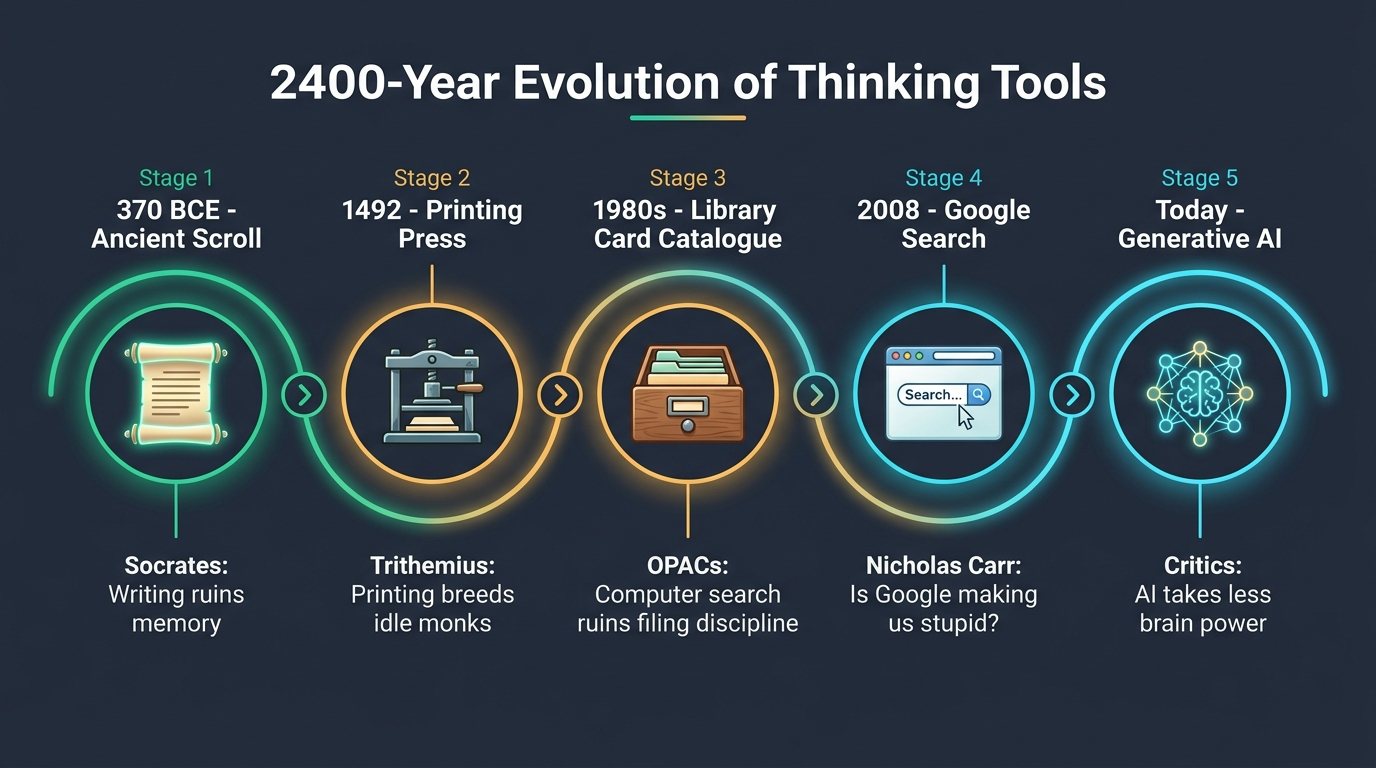
4. The 2,400-Year Timeline of Moral Panics: The Receipts
Every major leap in how humans store and share knowledge has sparked the exact same fear of mental decline. Here are the exact words critics used throughout history:
🏛️ 1. Ancient Greece (c. 370 BCE) — The Invention of Writing
In Plato’s Phaedrus, Socrates warned that the invention of writing would ruin human memory and give people the illusion of wisdom without real understanding.
"If men learn this, it will implant forgetfulness in their souls; they will cease to exercise memory because they rely on that which is written, calling things to remembrance no longer from within themselves, but by means of external marks.
They will be hearers of many things and will have learned nothing; they will appear to be omniscient and will generally know nothing; they will be tiresome company, having the show of wisdom without the reality."
— Socrates / Plato, Phaedrus (274c–275b)
The Modern AI Parallel: Today, critics say the exact same thing about ChatGPT and Gemini: "If students use AI, they will look like they understand essays or code without having actually learned anything."
📜 2. 15th Century (1492) — The Printing Press
When Johannes Gutenberg invented the movable-type printing press, Abbot Johannes Trithemius wrote a passionate defence of hand-copying manuscripts, claiming printed books were cheap, fragile, and made scholars lazy.
"Brothers, nobody should say or think: 'What is the sense of bothering with copying by hand when the art of printing has brought to light so many important books; a huge library can be acquired inexpensively.' I tell you, the man who says this only tries to conceal his own laziness.
The word written on parchment will last a thousand years. The printed word is on paper. How long will it last? The most you can expect a book of paper to survive is two hundred years... Every word we write is imprinted more forcefully on our minds since we have to take our time while writing."
— Johannes Trithemius, De Laude Scriptorum (In Praise of Scribes, 1492)
(The supreme irony: Trithemius had his own defence of hand-copying printed on a Gutenberg press so it would reach a wider audience).
📖 3. 18th Century (1795) — The Novel & "Reading Mania" (Lesewut)
When cheap novels became popular in the 1700s, doctors and commentators warned of "Lesewut" ("reading mania" or "reading madness"), claiming that reading stories all day damaged the brain.
"The reading of novels weakens the brain and makes the reader incapable of any continuous attention or productive labour... It causes an indigestion of the mind, a nervous fever, and an epidemic of undisciplined thought."
— Johann Georg Heinzmann, Appell an meine Nation (A Plea to My Nation: On the Plague of German Literature, 1795)
The Modern AI Parallel: Modern critics claim AI prompts cause "brain rot" and destroy our attention spans—using the exact same medicalised language once aimed at reading novels.
🗄️ 4. 1980s–1990s — Digital Library Catalogues (OPACs)
When libraries began replacing wooden card drawers with computer search terminals, traditionalists mourned the loss of manual filing.
"A card catalogue is a great, slow, physical repository of human effort... When you replace it with a computer terminal, keyword search becomes a blunt, blind instrument. It gives you the illusion of finding everything while depriving you of the tactile context of how knowledge was organised."
— Nicholson Baker, "Discards", The New Yorker (1994)
The Modern AI Parallel: Traditionalists mourned the loss of flipping through physical index cards; today, critics mourn the loss of clicking through ten blue search links.
🌐 5. 2000s — Google Search & "Digital Amnesia"
When Google Search became part of daily life, cultural critics and psychologists warned that search engines were ruining our ability to read deeply and think clearly.
"Over the past few years I’ve had an uncomfortable sense that someone, or something, has been tinkering with my brain, remapping the neural circuitry, reprogramming the memory. My mind isn’t going—so far as I can tell—but it’s changing. I’m not thinking the way I used to think.
I can feel it most strongly when I’m reading... Once I was a scuba diver in the sea of words. Now I zip along the surface like a guy on a Jet Ski."
— Nicholas Carr, "Is Google Making Us Stupid?", The Atlantic (2008)
"The internet has become a primary form of external or transactive memory, where information is stored collectively outside ourselves... When people expect to have future access to information, they have lower rates of recall of the information itself and enhanced recall instead for where to access it."
— Betsy Sparrow, Jenny Liu, Daniel M. Wegner, "Google Effects on Memory: Cognitive Consequences of Having Information at Our Fingertips", Science (2011)
5. Curated Video Receipts for Production & Research
These archival clips show that past panics over new technology sounded almost word-for-word like today's AI debates. They offer great visual hooks for essays and videos:
📺 1. 1981 News Report on the Future of the Internet (KRON-TV)
- Visual Hook: News anchors question whether anyone would ever read news on a computer screen. A family waits several minutes for text to render on a bulky CRT screen while wondering why anyone would give up their morning paper.
- Cinematic Function: A great opening hook showing how unfamiliar technology always looks awkward before it becomes second nature.
- Source: Watch on YouTube (KRON-TV 1981)
📺 2. Tomes & Talismans (1986, Mississippi ETV / MPB)
- Visual Hook: A 1980s post-apocalyptic sci-fi show produced to teach schoolchildren that the Dewey Decimal card catalogue is a mystical human ritual needed to defeat alien invaders.
- Cinematic Function: A fun visual example showing how manual searching was once treated as a sacred duty.
- Source: Watch on YouTube (Tomes & Talismans Episode 1)
📺 3. The Card Catalog: Past, Present and Future (Library of Congress)
- Visual Hook: Librarians and scholars in the 1980s debating whether computer terminals were making students lazy compared to physical index cards.
- Cinematic Function: Clear historical proof that the move from paper to search terminals faced the exact same pushback as Generative AI.
- Source: Watch on YouTube (Library of Congress)
📺 4. Does Google Make Us Stupid? (Nicholas Carr, 2008)
- Visual Hook: Nicholas Carr arguing that search engines and web browsing were rewiring our brains for rapid skimming instead of deep reflection.
- Cinematic Function: Shows that Google Search was once the villain, long before it became the comfortable baseline.
- Source: Watch on YouTube (Carr Keynote)
Note Evolution & Releases
Snapshot history as this thought was cultivated over time
V1.0 Seed planted: 3D isometric hero art, 2,400-year evolution timeline infographic, Bloom's Taxonomy AI pyramid with academic citations, and archival video receipts
Initial synthesis: gathered historical receipts from Socrates to Nicholas Carr and defined the cognitive scaffolding thesis
Discussion & Garden Notes
Share your insights, reflections, or critiques on this note.
Join the conversation
Sign in with Google to post comments, share technical perspectives, and connect your thoughts.
No thoughts planted yet.
Be the first to share an insight on this note!